
Medical assistant training
Training to become a medical assistant usually happens in a certificate or associate degree program, the kind offered by community colleges, vocational schools and universities. Most students finish within about 1 or 2 years, although plenty of career schools advertise faster paths. A postsecondary certificate is the standard entry-level education for this work, but some start with only a high school education and learn on the job. We list 1,094 programs across 50 states and Washington, DC.
What the law lets medical assistants do in six states
Prerequisites for medical assistant programs
For the Certified Clinical Medical Assistant (CCMA) exam, you need a high school diploma or GED, or must expect to earn one within 18 months).
Still in high school? Science courses pay off. The federal Bureau of Labor Statistics points to biology and chemistry, since the program will walk you through anatomy, medical terminology and pharmacology.
You don't have to go through a formal program at all: some people learn the work as an apprentice or through on-the-job training, which can take several months.
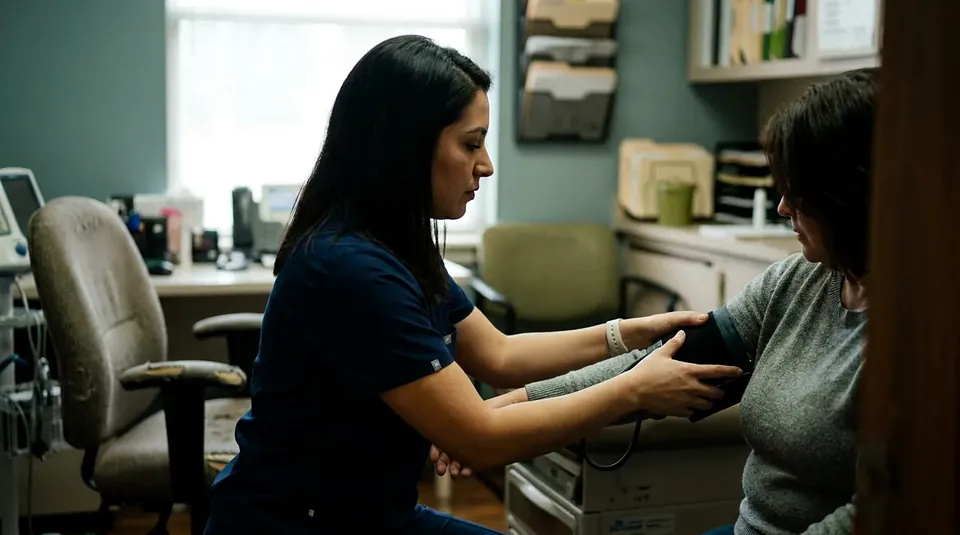
What do programs teach?
It's worth choosing an accredited program, which means an outside organization has reviewed what it teaches. Accredited coursework covers insurance and coding, lab techniques, clinical procedures, and pharmacology, including giving medications safely. It also touches first aid, front-office skills, working with patients and medical law and ethics. Among the programs in our listings, 484 hold accreditation: 310 through the Commission on Accreditation of Allied Health Education Programs (CAAHEP) and 181 at schools accredited by the Accrediting Bureau of Health Education Schools (ABHES).
Training requirements depend on the certification route. For the Registered Medical Assistant (RMA) credential, the American Medical Technologists (AMT) education route requires 720 hours of instruction, including at least 160 hours of externship. The American Association of Medical Assistants (AAMA) alternative pathway accepts programs equal to two semesters, with at least 560 hours of classes, not counting the practicum.
Individual states sometimes layer on their own rules. Washington takes accredited programs of at least 720 clock hours, and California insists on no less than 10 clock hours covering giving injections and skin tests. Planning to work somewhere specific? Check that state's rules before signing up.
The medical assistant externship
An externship, sometimes called a practicum, means supervised hands-on time in an actual clinic or office before graduation. This is where classroom skills meet real patients, with an experienced professional keeping an eye on you.
Programs accredited by CAAHEP have to build in at least 160 contact hours of this kind of supervised practice in a healthcare setting. The AMT education route and Washington's accredited-program route also require at least 160 hours of externship, so if you're aiming for one of those, expect a good stretch of time inside a clinic before you graduate.
How long does training take?
Of the 378 career schools reporting a completion time, the typical program runs 9 months, the quickest takes 2 months, and the slowest stretches to 32. Drawing on federal education data, here's the breakdown:
| Program length | Programs |
|---|---|
| Up to half a year | 19 |
| 7–9 months | 257 |
| 10–12 months | 59 |
| Over a year | 43 |
College and university programs generally take longer, roughly 1 or 2 years, and an associate degree is available at 354 schools.
Medical assistant night classes
If you need evening classes, ask the school whether it offers them, how long that schedule takes and when the externship happens.
Remember that the externship takes place inside a working clinic, so part of it may fall during daytime hours even if your classes happen in the evening.
Weekend medical assistant programs
Our listings don't track weekend schedules, so ask each school directly. One flexible option we can count: 30 programs can be finished fully through distance education, and 14 of them are accredited. For someone juggling a weekday job, that can be the more workable route.
Medical assistant programs for international students
If you're coming to the U.S. for career training like a medical assistant certificate, you'd usually study on an M-1 student visa, so ask the school early whether it accepts M-1 students.
Common questions
Who earns more, an MA or a CNA?
In May 2025, median annual pay was $45,690 for medical assistants and $42,260 for nursing assistants, according to BLS wage data. Median simply means half earned above that figure and half earned below it.
| Role | Median annual pay (May 2025) |
|---|---|
| Nursing assistants | $42,260 |
| Phlebotomists | $45,230 |
| Medical assistants | $45,690 |
| Licensed practical nurses | $64,400 |
| Registered nurses | $97,550 |
Is $30 an hour realistic for a medical assistant?
With a median hourly wage of $21.97, earning $30 an hour would put you well above what the typical medical assistant earned that year.
What does training cost?
Across the 392 career schools publishing a full-program price, the median comes to $17,257 covering tuition, fees and books. Meanwhile, at 437 public colleges, a year of full-time study carries a median in-district tuition and fees of $4,346.
Of the schools we list, 1,049 take part in federal student aid. Ask the financial aid office whether you and your program qualify.
Is medical assistant certification required?
A training certificate and a professional certification are different. A certificate is the typical education needed to enter this work, though some people start with a high school diploma and learn on the job. Certification routes have their own eligibility requirements, and states may also set requirements. Before choosing a program, ask whether it meets the rules for your intended certification and the state where you plan to work.